Pouring Money Into a Masterpiece: The Hard Truth About Professional C3 Restorations and Resale
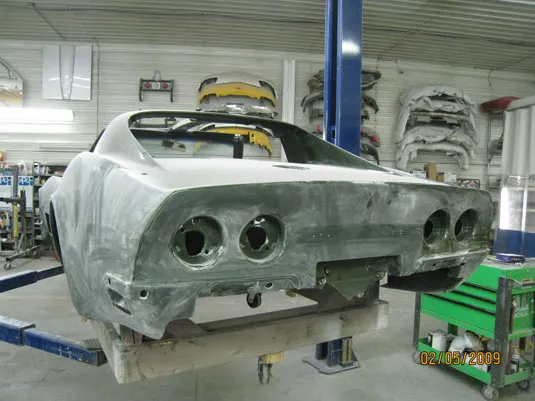
Photo: classic Corvette rotisserie restoration shop body work, via kissautobody.com
There's a moment every C3 Corvette owner knows. You're staring at a tired, sun-baked 1971 coupe that needs everything — floors, paint, frame work, the whole deal — and someone tells you to just do it right. Get it on a rotisserie. Find a good shop. Don't cut corners. Go all in.
So you do. And somewhere between the media blasting, the metal work, the new wiring harness, and the color-matched engine bay, you've dropped $55,000 on a car you bought for $18,000. The finished product is genuinely stunning. Concours-level paint. Every bolt torqued to spec. It looks like it rolled off the line in Bowling Green fifty years ago.
Then you try to sell it — and the market hands you a reality check you weren't ready for.
What a Rotisserie Restoration Actually Costs
Let's start with the numbers, because they matter. A proper rotisserie restoration at a reputable shop — one that strips the car completely, addresses every rust issue, resprays with correct lacquer or enamel, rebuilds the drivetrain, and documents everything — typically runs between $40,000 and $80,000 depending on the car's starting condition and the region of the country. In high-cost markets like Southern California or the Northeast, that ceiling can go even higher.
That's not counting the acquisition cost of the donor car. A solid, numbers-matching 1969 Corvette with a desirable engine code might already have a $25,000 to $35,000 price tag before a single wrench turns. Add restoration costs and you're looking at a total investment that can push $100,000 or more.
Restoration shop owners are usually pretty upfront about this math — even if their clients don't always want to hear it.
"We tell every customer before we start: this is not an investment strategy," says one shop owner who's been restoring C3s in the Midwest for over two decades. "We can make your car beautiful and correct, but we cannot make the market pay you back dollar for dollar. Those are two completely different things."
Why the Market Doesn't Care What You Spent
Here's the uncomfortable truth: buyers don't reimburse sellers for their restoration bills. When someone is shopping for a C3 Corvette, they're comparing your car to every other car at that price point — regardless of what it cost to get there.
A freshly restored 1972 Corvette T-top with small-block power might be worth $45,000 to $55,000 in today's market, depending on options and documentation. That ceiling doesn't move just because the seller spent $70,000 getting it there. The buyer is paying for the car, not the invoice from the body shop.
This is what collectors call the "restoration premium paradox." The market rewards originality and documented history almost as much — sometimes more — than a fresh restoration. A well-preserved, unrestored C3 with matching numbers and a known history can command serious money precisely because it hasn't been touched. Once you restore a car, you're essentially replacing its history with your judgment calls, and not every buyer agrees with those calls.
Paint color choices, interior materials, chrome versus correct cadmium plating — every decision made during a restoration is a potential objection for a future buyer.
Where Restorations Actually Add Value
This isn't to say professional restorations are a waste of time. Far from it. The key is understanding where the value gets added — and where it doesn't.
For C3s in the most collectible window — think 1968 through 1972, especially big-block cars and cars with factory options like side pipes or the Muncie four-speed — a documented, correct restoration can meaningfully push values above baseline. These cars have a deep collector following, and buyers in this segment often want a car they can show competitively. A proper restoration, with receipts and period-correct documentation, can close the gap between cost and return more effectively here than anywhere else in the C3 range.
Lower-demand model years are a different story. A 1979 Corvette with a base engine and a $50,000 restoration behind it is going to struggle at auction regardless of how beautiful it is. The market for late C3s is thinner, and the ceiling on values is lower. You can build a perfect car that simply doesn't have a buyer pool willing to pay what it deserves.
What Restoration Shops Want You to Know
Spend any time talking to people who actually do this work for a living and a few consistent themes emerge.
First, scope creep is real. Cars that come in for a "partial" restoration almost always end up becoming full restorations once the disassembly begins and hidden problems surface. Owners who budget for a $25,000 job frequently end up at $45,000 or $60,000 before the car is done — and that's not the shop padding the bill. That's what happens when you pull a car apart and deal with 50 years of deferred maintenance, amateur repairs, and rust that wasn't visible from the outside.
Second, documentation matters enormously for resale. Shops that photograph every stage of the process, retain original parts, and provide a full restoration binder are doing their customers a genuine service. That paper trail becomes part of the car's story, and serious collectors pay attention to it.
Third, the emotional return is real even when the financial return isn't. A lot of owners aren't restoring these cars to flip them. They're doing it because they want to drive something magnificent, or because the car has personal meaning, or because they simply love the C3 generation and want to experience it at its best. That's a completely legitimate reason to spend the money — as long as you're not expecting the market to validate it.
Making a Smarter Decision Before You Commit
If you're standing at the crossroads right now — weighing whether to send your C3 to a professional shop for a full restoration — here's what the people who know this space best would tell you.
Get a pre-restoration appraisal. Understand the realistic ceiling on your specific car's value before you spend a dollar. That number should anchor your budget decisions.
Consider a driver-quality restoration over a concours restoration if resale is part of your plan. Getting a car mechanically sorted, safely driving, and cosmetically presentable for $15,000 to $25,000 is often a smarter move than chasing perfection at three times the cost.
And if you're going all in on a full rotisserie job, do it on a car that deserves it — a numbers-matching, high-option, early C3 with a story worth telling. Those are the cars where the investment has the best shot at making sense.
Everything else? Enjoy the process, love the result, and make peace with the fact that the market may never agree with your accountant.
That's the real cost of bringing a C3 back to life — and honestly, for most of us, it's still worth it.